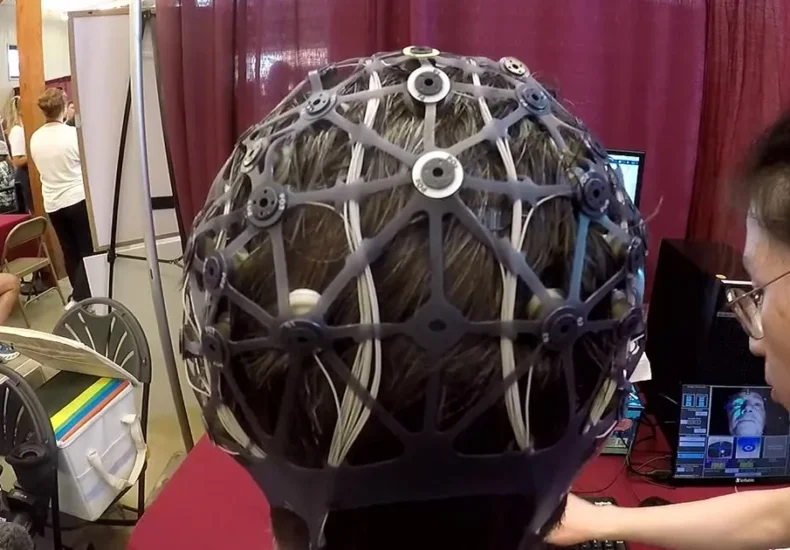
At Minnesota State Fair, Tetris Players Can Help University of Minnesota Researchers Track Brain Planning With Eye Movements and EEG Caps
FALCON HEIGHTS, MN — Playing Tetris at the Minnesota State Fair now comes with a science twist. University of Minnesota researchers are asking volunteers to place falling blocks while wearing a brain-monitoring cap and an eye-tracking system.
The setup lets scientists compare keyboard clicks, eye movements and EEG activity at the same time. The goal is to better understand how the brain plans ahead, not just how it makes a single quick decision.
How the Tetris study works
Jean-Paul Noel, a neuroscience professor at the University of Minnesota, said the experiment looks at how people scan the Tetris board, what moves they choose and how their brain signals change as they decide where a piece should go. He described EEG as tiny voltage fluctuations measured on the scalp.
Noel said the researchers are especially interested in the link between what someone sees, what they do with their hands and how the brain organizes several steps of thinking at once. Tetris is a useful test because it naturally pushes players to think ahead while adjusting to changing shapes and openings on the board.
The study takes about 30 minutes. University of Minnesota staff said they are looking for participants across a wide age range, especially people closer to 14 and closer to 80, as long as they have no history of epilepsy.
Why the State Fair is the draw
Noel said much neuroscience work relies heavily on college students, which can leave out a lot of the public. By bringing the study to the State Fair, the team can meet people from different ages, education levels and backgrounds in one place.
He said this is the research group’s first year at the fair, making it a kind of baseline for future work. Over time, the team hopes to follow participants and see how planning abilities change as people age.
Noel also said the setting matters. The fair allows researchers to do more naturalistic science, both in the game people play and in the environment where they play it.
A bigger research building full of volunteers
The Tetris project is only one part of a much larger research effort inside the State Fair Research Building. Ellen Demerath, co-director of the State Fair Research Program, said this year is the biggest yet for the number of studies on site.
Organizers say there are more than 60 research projects running during the 12 days of the fair, with hopes of drawing as many as 20,000 volunteers. The studies cover children, adults and older people, and families can often take part together.
Demerath said the range of projects is designed so grandparents, parents and kids can all find something they can do. For fairgoers, that means a trip for food and rides can also turn into a quick stop for science.
The weirdest true stories from across America, every day.
Leave a Reply